Getting to the next egg is easy to focus on. The harder question is where you will go after eating it. As your snake gets longer, a short route can lead into a space you cannot leave.
This guide uses Nines Snake to work through that decision, explain first-person steering and show when a power-up will help. Play Snake if you want to try it alongside the examples. You can finish five guest games before a free sign-in is required.
In this guide
Look beyond the next egg
In Nines Snake, eating an egg makes your body longer. The snake also gets faster as it eats more eggs, up to a speed limit. You cannot reverse directly into your neck, and hitting your body or the stone boundary ends the run unless a shield saves you.
Before turning towards an egg, look for two things: a route to it and a route away from it. An empty square is useful only if you can reach it without crossing your body. A large empty area on the other side of your tail does not give you an immediate escape.
The diagrams below are simplified board illustrations, not screenshots. Their routes were checked with the same movement and collision code used by Nines Snake. They show the upper-left part of the board; the playable area continues below and to the right.
Example: the egg you should leave alone
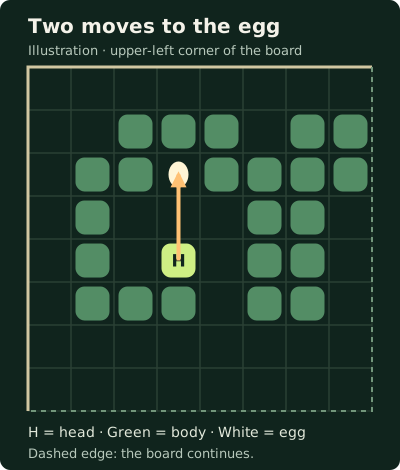
The arrow shows two moves straight ahead. The white egg is reachable, but the green body surrounds the space beyond it.
At first glance, this looks like a free egg. Keep moving up for two steps and you collect it. But now look at the three possible next directions. Above the head is your body. To its left is your body. To its right is your body. Going back down would be a reversal into your neck, which the game does not allow.
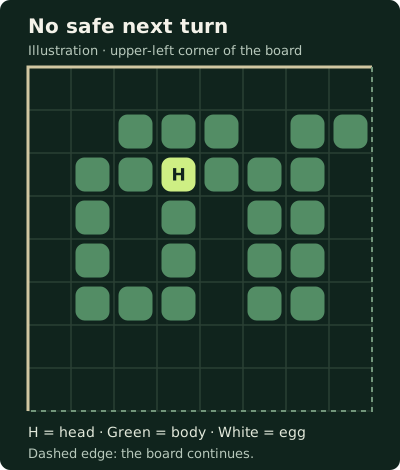
After the second move, there is no safe next turn. The tail has moved, but not enough to open any of these three exits.
This is why “the tail will move out of the way” is not a reliable answer on its own. It matters which part of the body blocks you and how soon it will leave. Here, all three exits are still occupied when you need to move again.
From the original position, there is another choice:
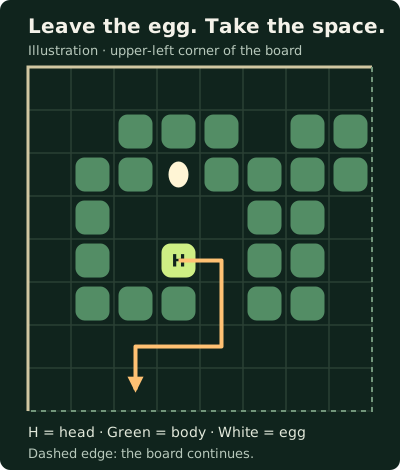
Right, down, down, left, left, down. These directions refer to the overhead board.
That route leaves the egg alone and takes you into open space. All six moves are safe in this position. It does not guarantee the rest of the run; you still need to plan the next turn as your body moves. The useful habit is to choose space over an egg when collecting it would end the game.
First-person turns are relative to the snake
Top view gives you an overhead view of the board. Arrow keys or WASD choose a direction on that board. In Snake-eye view, Left and Right, A and D, or horizontal swipes turn relative to where the snake is facing.
For example, imagine the snake is travelling downwards on the overhead map. Pressing Left in Snake-eye view turns it towards the right-hand side of that map. That is the snake's left, even though it is your right when looking down at the board.
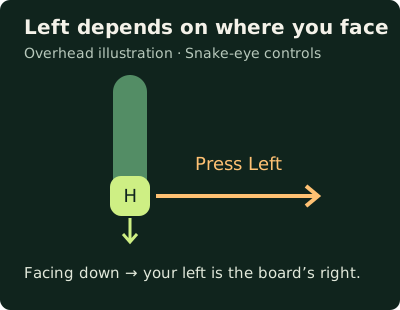
An overhead illustration of a first-person left turn. It is not a picture of the Snake-eye camera.
The small overhead map helps you see where your body is while the camera faces forward. Check it before entering a narrow gap. If you lose track of your position, switch back to Top view. You can also pause with P or Escape; the controls reference covers both views and touch controls.
Practise a single left turn and a single right turn in open space before trying to steer around a long body. The route in the previous example uses board directions, so follow it in Top view rather than treating that list as first-person key presses.
What the power-ups can and cannot save
Power-ups help with different problems. None makes every route safe.
| Power-up | What it does | What to watch for |
|---|---|---|
| Slow time | Slows movement for 8 seconds. | Your normal pace returns when it expires. |
| Double points | Doubles each egg's points for 10 seconds. | Body and boundary collisions still count. |
| Shield | Saves one collision, for up to 16 seconds or until used. | It is spent after the rescue. You need to steer away. |
Consider the trapped egg again. With Double points active, collecting it awards twice the points, but the same three exits remain blocked. The next collision still ends the run. A scoring bonus does not change the shape of the board.
Shield behaves differently. When it catches a collision, the snake stops briefly and the game tells you to turn. It does not let you pass through your body or the boundary. If you were heading into a wall with empty space beside you, that pause gives you a chance to turn away. In a pocket with no open exit, a shield cannot create one.
The first pickup can appear once both 20 seconds have passed and you have eaten four eggs. It stays available for eight seconds. Later pickups need another four eggs, at least 30 seconds between appearances and no active power-up. You do not have to chase every one: missing a pickup is better than crashing on the way to it.
Try one change in your next run
For your next game, make the question “where do I go after this egg?” part of each approach. Start in Top view if that makes the whole route easier to see. Once the habit feels natural, try the same planning with the Snake-eye map.
Play Snake and leave yourself room for the next turn.